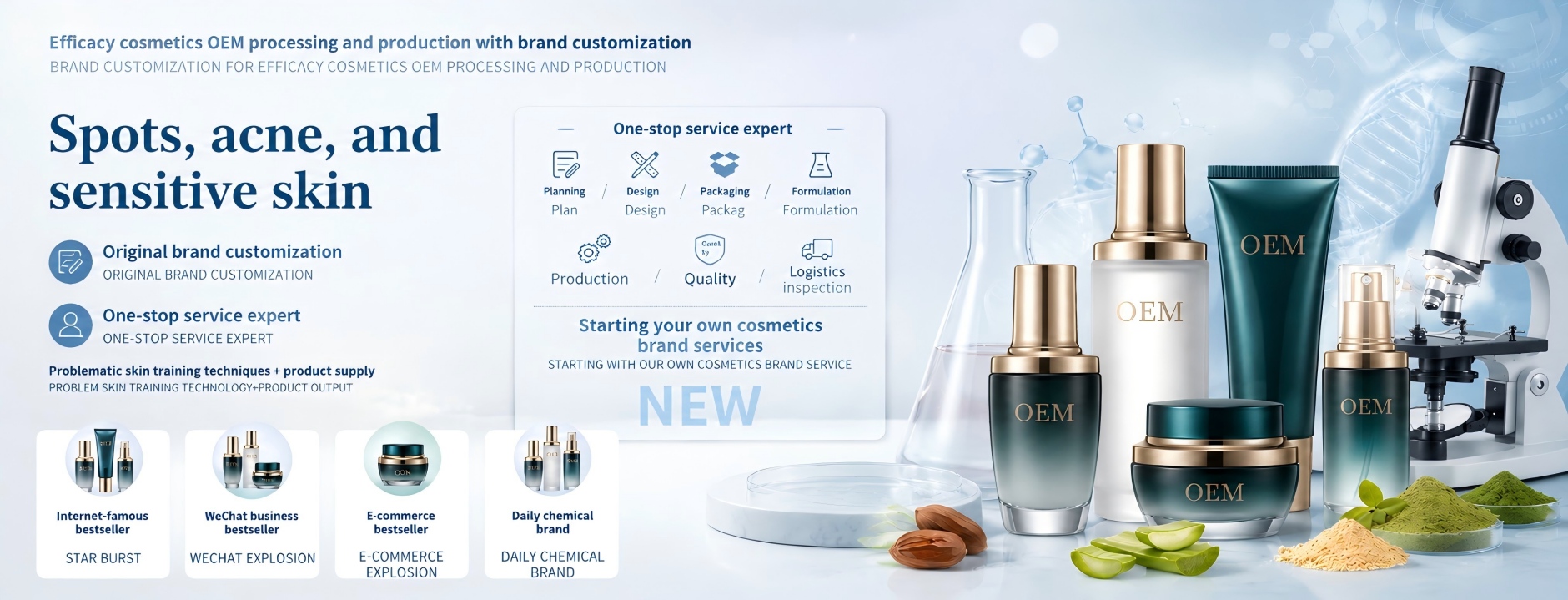
In the cosmetics industry, contract manufacturing is nothing new. Over 70% of emerging Chinese beauty brands have their products formulated and filled by professional contract manufacturers. The brand tells the story and builds the channels; the manufacturer works behind the scenes to turn "concepts" into "safe, effective products in a bottle."
But many newcomers to the industry still find themselves confused by the three letters—OEM, ODM, and OBM. What exactly sets them apart? Which model best suits your brand's current stage? Could choosing the wrong one hold your brand back?
This article will walk you through the three core models of cosmetic contract manufacturing and help you find the right path for your brand.
## 1. First, Understand What These Three Letters Actually Mean
The key distinction comes down to one question: **Who owns the formula, who owns the brand, and how deeply does the factory get involved?**
### 🔧 OEM: Brand-Led "Contract Manufacturing"
**OEM** stands for Original Equipment Manufacturer—commonly understood as "contract manufacturing" or "private-label production."
In this model, **the brand provides its own formula, production standards, and packaging design**. The factory's role is strictly execution: sourcing raw materials, emulsifying, filling, and conducting quality control according to the brand's technical specifications. Think of the brand as the "architect drawing the blueprints" and the factory as the "builder following those plans."
**Key features:**
- Intellectual property (IP) belongs to the brand; formulas and technologies stay in-house
- Brand must have its own R&D team or purchase exclusive formulas
- High product uniqueness—fully embodies the brand's unique vision
- Longer development cycle due to independent R&D and validation
**Best for:** Established brands with R&D resources, companies with proprietary core technologies or exclusive formulas.
### 🧪 ODM: Factory-Powered "One-Stop R&D & Production"
**ODM** stands for Original Design Manufacturer—in the beauty industry, this essentially means "one-stop R&D and production."
In this model, **the factory's role shifts from "executor" to "solution provider."** The brand simply presents a product concept and requirements (e.g., "I want a repairing serum for sensitive skin"), and the factory handles everything: formulation development, sampling, packaging recommendations, and full-scale production.
**Key features:**
- Factory leads R&D; the brand can participate or choose from existing solutions
- Low barrier to entry—no need to build an in-house R&D team
- Development cycle shortened by 30%–50%—fast market response
- Formula IP typically belongs to the factory; brand operates under license
**Best for:** Startups, cross-industry brands, first-time founders, teams pursuing "small-batch, fast-turnaround" production.
### 🏢 OBM: Factory Takes On "Full Brand + Product" Services
**OBM** stands for Original Brand Manufacturer—the deepest level of factory involvement.
In this model, **the factory not only handles R&D and production but also participates in brand positioning, go-to-market strategy, and even marketing support**. From market and competitive analysis, product development, and manufacturing to brand building and promotional strategy, the factory provides comprehensive support to help the brand take shape and grow.
**Key features:**
- Factory offers end-to-end services—from brand positioning to product launch
- Brand simply approves the solution and receives finished goods
- Demands the highest capability in brand-building and market development from the factory
- Broadest scope of services, typically with higher profit margins
**Best for:** Factories launching their own brands, complete beginners with no brand operating experience, hands-off investors.
### 🚀 Early Stage (0 to 1): ODM is Your Best Bet
When you're just starting out, resources and specialized teams are often limited. ODM allows you to launch products quickly with a low barrier to entry, test the market, and validate your concept. You can choose a formula from the factory's existing library or customize it slightly—saving significant R&D time and upfront investment.
**Critical reminder:** If you go the ODM route, be sure to include **exclusivity clauses** in your contract to prevent the factory from selling the same formula to other brands, which would dilute your product's uniqueness.
### 📈 Growth Stage (1 to 10): Consider "ODM + Gradual In-House Development"
Once your brand has market validation and some capital, you can start transitioning toward OEM. You can lead the formula development yourself and hand it off to the factory for production, ensuring core IP stays in your hands. Alternatively, deepen your involvement in formula customization under an ODM arrangement, rather than leaving everything to the factory.
### 🏆 Mature Stage (10 to 100): OEM or In-House Manufacturing
Leading brands typically operate under OEM models or build their own factories. At this scale, brands need tighter quality control, greater supply chain stability, and strategic flexibility. Going OEM allows you to:
- Exercise fine-grained control over product specifications and quality
- Reduce reliance on any single supplier
- Keep core technologies and formulations securely in-house
- Avoid technology leakage risks
## 4. What to Look For When Choosing a Contract Manufacturer
Regardless of which model you choose, these hard criteria are non-negotiable:
1. **Qualifications & Certifications**: The factory must hold a *Cosmetic Production License*, operate a cleanroom meeting Class 100,000 (ISO 8) standards, and ideally be certified under both ISO 22716 and GMPC.
2. **R&D Capability**: For ODM/OBM partnerships, evaluate whether the factory has a professional R&D team, well-equipped laboratories, and a robust formula library.
3. **Category Expertise**: Different factories specialize in different categories—some excel in masks, others in serums or sunscreens. Find one with proven experience in your specific product category.
4. **Minimum Order Quantity (MOQ) & Lead Time**: The trend in 2026 is "small-batch, fast turnaround." Many top-tier factories now offer flexible production lines supporting MOQs as low as 1,000–5,000 units—very friendly to new brands.
5. **Regulatory Compliance**: Between 2025 and 2026, over 950 cosmetics manufacturers have had their licenses revoked. The industry is undergoing a shakeout—"low-end fillers exit, technology-driven manufacturers consolidate." Partnering with a fully compliant factory is your lifeline to getting products to market smoothly
**Final word:** Choosing a manufacturing model isn't a one-time, irreversible decision. Many brands start with ODM, validate the market, then gradually transition toward OEM—it's an evolutionary process. The key is to pick the model that best fits your current stage and available resources, rather than aiming for perfection from day one.
#OEM vs. ODM vs. OBM: Which Contract Manufacturing Model Fits Your Brand Best?
2026-09-09
Recommended
You might also like
2026-09-09
Cosmetics OEM
The Complete Guide to Cosmetic Manufacturing Process: From Formulation to Finished Goods
The Complete Guide to Cosmetic Manufacturing Process: From Formulation to Finished Goods